
 admin
Alternate reality games, ARGs for short, have become something of a recurring marketing tactic in the modern information age. The basic idea is that some manner of mystery or puzzle is seeded somewhere where users can find it, maybe in marketing materials, in an update’s patch notes, or just hiding somewhere within a game itself.
This can happen both before and after a game’s release, and can contain hidden information about the game’s world or characters, or even divulge information about the game itself like its title or release date. Sometimes, it’s so mysterious, it’s not even clear if it’s actually real, like the alleged Half-Life 3 ARG.
Quite a few games have dabbled in ARGs over the years with varying degrees of complexity. In general, though, it’s a pretty good way to get your audience invested in a game’s deeper workings, kind of like a digital scavenger hunt for breadcrumbs of lore and data. You put a mystery in front of enough people, odds are good at least a few of them are going to go whole-hog on trying to solve it.
These are some of the best games to employ ARGs over the years, either pre- or post-release.
8
AI: The Somnium Files – nirvanA Initiative
Nine Eyes TV
If you’ve ever played one of Kotaro Uchikoshi’s puzzle and escape room games, you know he likes to pepper his narratives with a lot of deep-cut sociological and scientific concepts. For the second AI: The Somnium Files game, the soup du jour just happened to be alternate reality games, which were used both to promote the game’s release and within the game’s story itself.
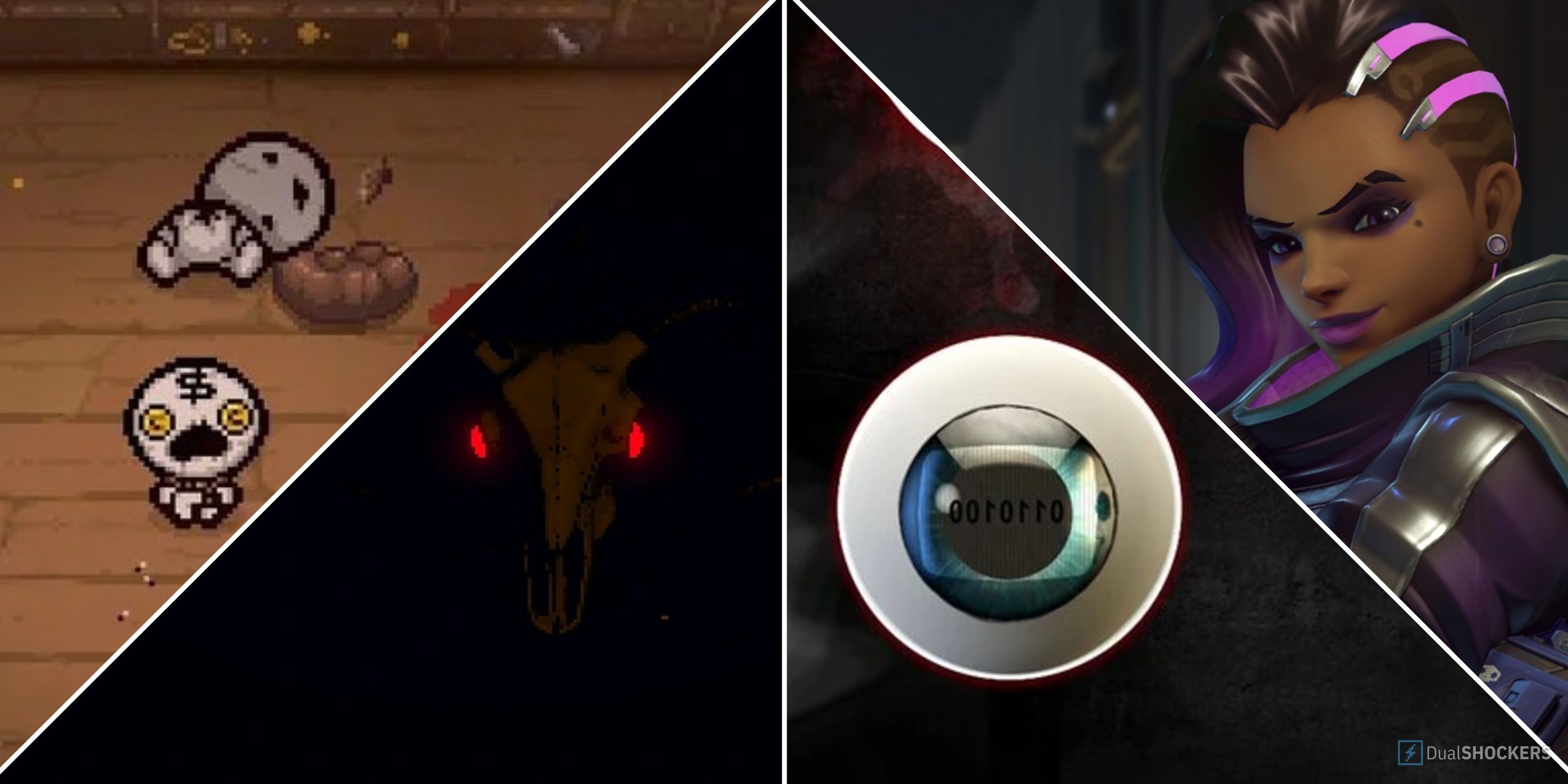
In the former case specifically, as the latter would spoil stuff, prior to the game’s launch, Spike Chunsoft launched a promotional ARG website titled “Nine Eyes TV.” As the name implies, this mysterious web page featured nine large eyeballs. Clicking on an eyeball would reveal a puzzle, and successfully solving it would give you a piece of a password.
When you had all the pieces of the password, two things would become clear. Firstly, the password itself spelled out “NIRVANAINITIATIVE,” revealing the game’s subtitle for the first time. Secondly, inputting the password into the site would take you to a countdown page, and when that countdown ended, the game’s first announcement trailer was released on YouTube.
7
The Binding Of Isaac: Rebirth
Finding The Keeper

Alongside the initial release of The Binding of Isaac: Rebirth, the game’s creator, Edmund McMullen, programmed in what was supposed to be an elaborate bread-crumb-trail ARG that would culminate in the game’s community learning how to unlock the secret character, the Lost. Unfortunately, dataminers uncovered the Lost and its unlock conditions almost immediately, and the entire puzzle was a wash.
For his second attempt at an ARG alongside the release of the Afterbirth DLC, McMullen put some extra elbow grease in to ensure nobody could break the rules this time. This new puzzle had an extremely obtuse series of steps that required not just unlocking certain achievements in the game’s new Greed Mode, but even making actual phone calls and learning to read real-life coordinates.
About a month after the hunt started, a new message began circulating on a voice mail that Reddit users had uncovered which, when translated into alphanumeric code, revealed a set of GPS coordinates.
Reddit users followed these coordinates to a building in Santa Ana, California and discovered a pile of discarded change, within which was buried a little doll covered in scrawlings. By making a Twitter account for this doll, the challenge was complete, and the game was updated with its new secret character, the Keeper.
6
Overwatch
The Hunt For Sombra

Back when the original Overwatch was first released, enterprising fans had a ball exploring the game’s various maps for scraps of lore and information. A particular name that seemed to keep coming up was “Sombra,” but at the time, nobody knew who that was.
Starting with Ana’s reveal trailer, though, Sombra’s presence throughout the game and its promotional material started to become more pronounced, implying there was more to uncover here.
Carefully picking apart promotional content revealed a trail of virtual clues, including a field of hexadecimal values, a QR code, datamoshed photos, and mysterious, random achievements. Each of these clues revealed taunting messages in Spanish, as well as a recurring image of a skull drawn in ASCII art. Whoever this “Sombra” was, they were quite the trickster.
The clues kept releasing at a steady clip throughout the back half of 2016 before finally culminating in Sombra’s full character reveal trailer at BlizzCon 2016. In all likelihood, she probably would’ve been revealed whether the code was cracked or not, but it was a fun indicator of the character’s personality prior to her arrival.
5
Batman: Arkham Asylum
The ArkhamCare Website

Prior to the release of the very first Batman: Arkham game, the game’s publishers put up a real-life version of the Arkham Asylum website, titled ArkhamCare. It looked like a bog-standard hospital website, with a fake newsletter, an About Us section, and a soundbite from Warden Quincy Sharp. Hidden within these innocuous details, though, was a back-end login page for Arkham staff.
The premise of this ARG was that you had been contacted by an anonymous individual who wanted access to Arkham’s back end in order to find proof that Sharp had played some role in the in-universe fire that had destroyed Blackgate Prison and got most of its inmates relocated to Arkham. You could find information about Sharp’s shady dealings by browsing through the worker profiles in the hidden back-end.
In reality, this was all a ploy by Edward “The Riddler” Nygma to trick various individuals into getting him access to Arkham’s servers so he could take control of the place. You know how, at the start of Arkham Asylum, Joker takes control of the whole facility pretty much immediately? Yeah, you did that. Whoops.
4
BioShock 2
There’s Something In The Sea

Prior to the release of BioShock 2, 2K and Irrational launched a new promotional website titled “There’s Something in the Sea,” intended to both shed some light on what’s gone on in the soggy depths of Rapture post-BioShock and give us an idea of what we were in for in the sequel.
The premise of this site was an investigation conducted by a man named Mark Meltzer, who was originally investigating a series of disappearances of young girls from shores all over the world. After getting in a bit too deep, his daughter Cindy is spirited away by a mysterious stranger, eventually revealed to be a Big Sister.
Meltzer’s investigation was split up into several pages, including maps and locales following his travels and search, each containing small snippets of a wider conspiracy surrounding individuals searching for those who departed for Rapture.
Interestingly, Meltzer’s search was actually incorporated directly into BioShock 2. An audio log detailing his arrival in Rapture is one of the first you find in the game, and you can find subsequent audio logs detailing his exploration of the city as you go.
3
Deltarune
The Spamton Sweepstakes

Toby Fox has always had a knack for sneaking little tidbits about his games wherever he can. I guess it shouldn’t be that surprising, then, that any and all events even related to his works would also have their fair share of secrets to uncover. One such event was the Spamton Sweepstakes, released between chapters 2 and 3 of Deltarune.
The Spamton Sweepstakes was, on the surface, a massive charity sale event in support of the organization Child’s Play starring everyone’s favorite little marketing gremlin, Spamton G. Spamton. It actually was this, and raised quite a bit of money. In addition to that, though, the sweepstakes website was home to quite a few hidden links, which you could uncover by clicking around and navigating a proverbial maze.
These links revealed characters and environments from chapter 3, as well as entries from Noelle’s blog, which shed some light on the characters and relationships of the residents of Hometown. By now, this is mostly information we know about, but at the time, any scrap of information we could get about upcoming chapters was worth pursuing.
2
Inscryption
The Secret Of The OLD_DATA

The entire premise of Inscryption is that it’s a recording of a streamer playing an old PC game he found buried in a forest somewhere after tracking a series of coordinates he found on some old trading cards. It kind of goes without saying that a game like that would have at least some kind of ARG baked into it, and naturally, it does.
The initial trigger for the ARG is found in one of the game’s live-action cutscenes depicting the aforementioned streamer, specifically a long hexadecimal code scrawled out on a napkin. This code needs to be merged with several other codes found throughout the game, some during boss fights, some during exploration during the game’s second and third acts, and some even in the game’s credits.
With the full decryption key, you need to directly edit your save file. When loading, you’ll receive a special message, followed by the game hard-crashing. All of this, however, was just part one of the ARG, with the second part requiring you to play the console port to uncover.
Both pursuing and completing the whole mystery gives you more insight into the game’s backstory, including the company GameFuna and the mysterious OLD_DATA.
1
Portal 2
The Potato Sack

Quite possibly one of the most ridiculous ARGs that I’ve ever personally participated in was created to hype up the admittedly already pretty hyped release of Portal 2. It wasn’t just elaborate, it was incredibly profitable, scoring sold copies for a slew of indie games, whose developers all pitched in to contribute. This project is collectively known as the “Potato Sack.”
One fine day in 2011, a bundle of discounted indie games was promoted on Steam, including titles like Audiosurf, BIT.TRIP Beat, Super Meat Boy, and others. Players noticed that every game on the list had received an update at the same time, now containing myriad hints, puzzles, and teasers with a distinct Aperture Science flavor. A subsequent update revealed an Aperture Science staff login page, which revealed snippets of concept art.
Special achievements were added to the participating games, with every one obtained adding more potatoes to the ARG screen. Players who were notorious for their involvement in the hunt suddenly began disappearing from forums, as though they were spirited away by GLaDOS. In the final stretch, a countdown appeared, which began ticking down faster the more players were playing the Potato Sack games.
Finally, Portal 2 officially launched, apparently a good 10 hours earlier than planned, thanks to player participation.
